Riding the Trend: Buying Pullbacks and Knowing When to Sell
Missing the breakout isn't a tragedy. Strong trends offer second chances — if you know where to look for them.
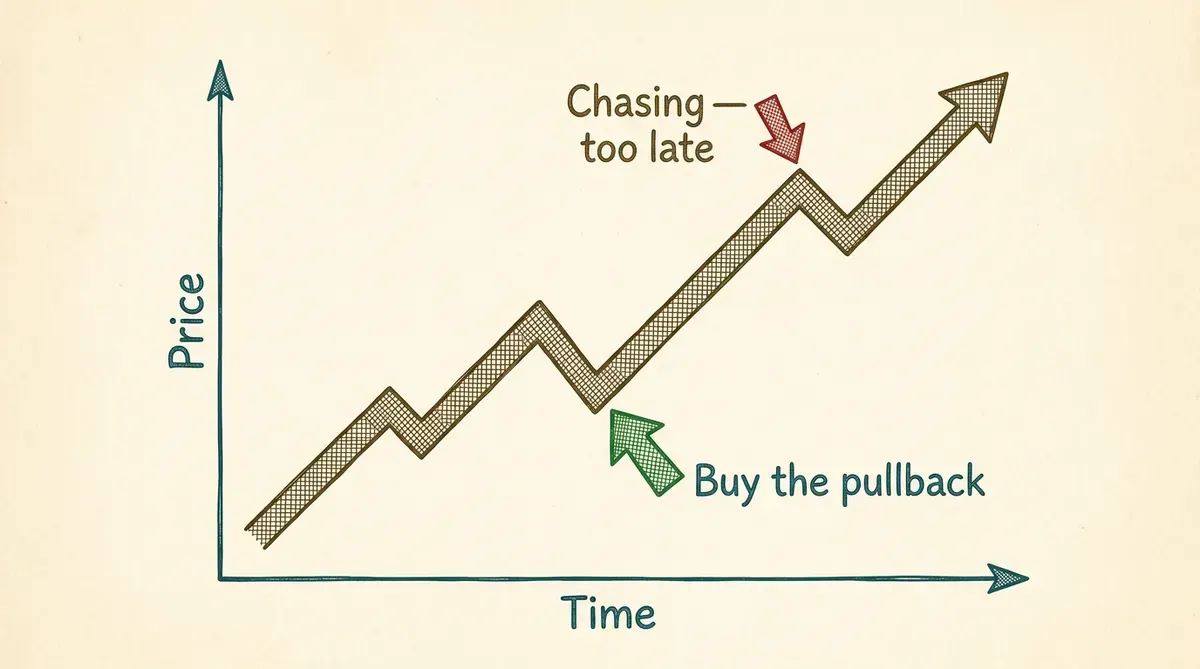
The move you "missed" probably isn't over
Every investor knows the sting: you spot a great stock, hesitate, and it runs 25% without you. The instinct now is either to chase it (buying someone else's profit-taking) or to write it off ("too late").
Both instincts are usually wrong. Strong trends last far longer than most people expect — months, often years — and they don't move in straight lines. They advance, rest, dip, and advance again. Those resting dips are called pullbacks, and buying them is one of the highest-probability entries in all of trading: you're joining a proven trend at a discounted price, at the very spots where big buyers historically step back in.
Why pullbacks find support where they do
The most useful map for a trend is a pair of moving averages — commonly the 50-day for the medium-term trend, and the 150- or 200-day for the long-term trend. A healthy uptrend rides above both, and pullbacks tend to stop falling near them with almost uncanny regularity.
There's nothing magical about it. Moving averages work as support because of who is waiting there:
- Institutions buy the dip on schedule. Funds that want more of a winning stock but refuse to chase set their buy orders around exactly these widely-watched levels. The 50-day average is, in effect, where disciplined money queues up.
- The trend's own math. The moving average roughly represents the average holder's cost over that period. Near it, the "late buyers" who might panic are back to breakeven and stop selling, while believers see fair value.
- Self-fulfilling attention. Because millions of traders watch the same lines, the reaction at those lines becomes part of market physics.
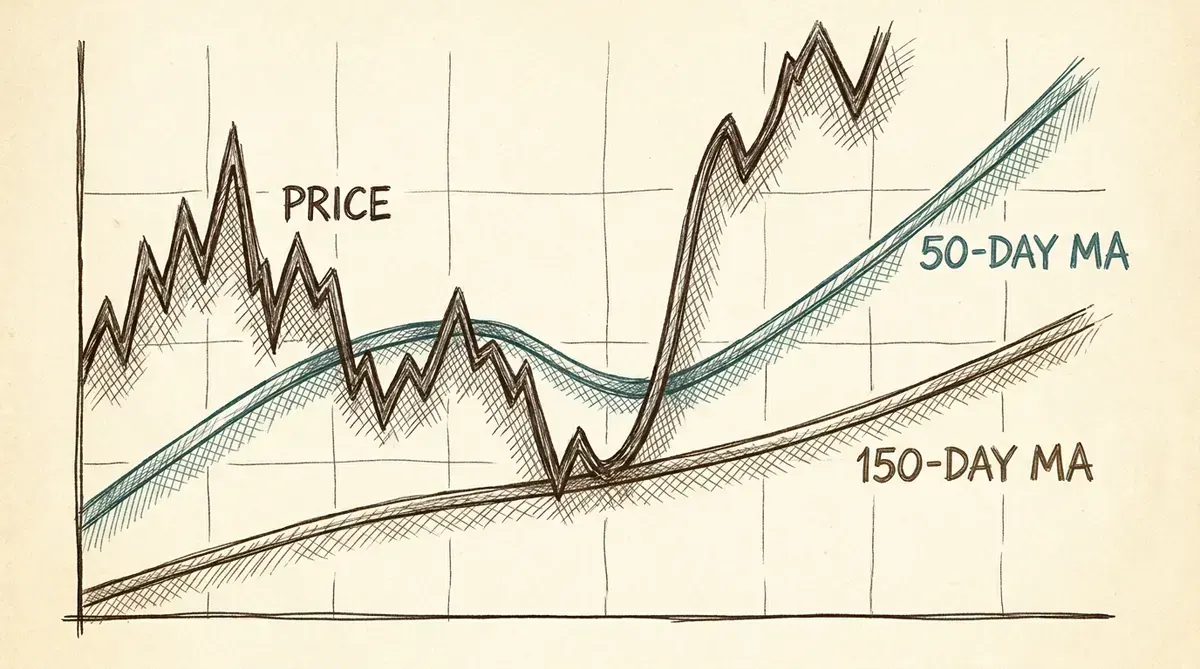
What a healthy pullback looks like
Not every dip is a buying opportunity — some dips are the beginning of the end. The difference is usually visible in three places:
- Volume. A healthy pullback happens on quiet, shrinking volume — holders are relaxed, and the dip is caused by an absence of buyers rather than an avalanche of sellers. A drop on heavy volume means big players are leaving. That's not a discount; it's a warning.
- Depth and character. Orderly drifts of a few percent toward the 50-day average are routine. Deeper pullbacks toward the 150-day average happen a few times a year even in great trends and can be the best entries of all. But a violent crash through both averages is a different animal entirely.
- Context. Is the stock's sector still strong? Is its theme still working? Is the market itself just resting? A stock dipping alongside a calm market rest is normal; a stock collapsing while its peers rally is telling you something specific — and bad.
The entry itself: patience, then evidence. Let the stock come to the level — don't buy on the way down — and wait for the first sign that buyers are back (an up day, ideally with volume returning). Your stop-loss goes below the pullback low. Risk a little to rejoin a trend that could run for months more.
The other half: knowing when to sell
Buying well is pleasant. Selling well is profitable. Two failure modes destroy most trend-followers' results — selling winners too early, and holding broken trends too long — and both are cured by rules rather than feelings.
Rule 1: A healthy trend gets to keep running. Up 30% is not a reason to sell. Nothing about your entry price matters to the market. As long as the stock rides above its rising long-term average and pullbacks stay orderly, the trend is innocent until proven guilty. This is emotionally hard — every day you'll be tempted to "lock in" gains — but the entire mathematics of trend following depends on your winners paying for your losers many times over.
Rule 2: A broken trend gets sold without debate. The market tells you when the stage has changed:
- Price closes decisively below the long-term moving average — and stays there. (The same level that supported the trend now becomes the tripwire.)
- Pullbacks change character: heavy-volume declines, feeble low-volume bounces.
- The moving averages themselves flatten and roll over.
When you see this, sell — even though it will feel like the worst time, even though the stock is "cheaper than last month." The stocks that destroy portfolios are almost always former winners that someone refused to sell after the trend broke, riding a 20% dip into a 70% catastrophe.
A useful middle path: sell in pieces. Take a partial profit into unusual strength (a euphoric gap-up, a vertical acceleration far above the moving averages), and hold the rest with the trailing rule. You'll never nail the exact top — nobody does — and partial selling makes that fact painless.
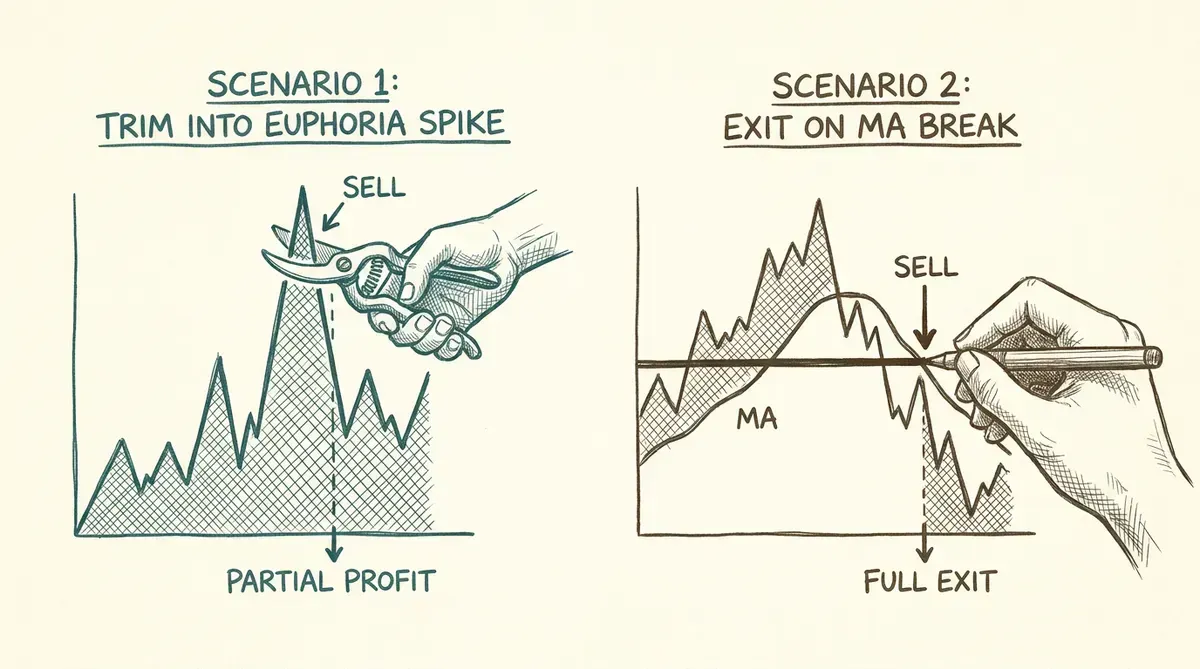
The monitoring problem (and its solution)
This whole playbook rests on something unglamorous: watching. You have to notice when quality stocks pull back to their moving averages, track whether volume behavior is healthy, and keep tabs on the trend status of everything you own — daily, across the whole market.
That's the part Relaxfolio does for you. Ask it for "pullbacks" and it returns uptrending US stocks that have dipped back near long-term support — with how far each sits from its moving average, its trend strength, recent performance, and its sector and theme, all in one ranked table. Ask "trending stocks" to review the leaders, or type any ticker to check the health of a trend you're riding — chart, moving averages, volume behavior, and the news that actually matters.
Save a pullback screen to support regular review and receive email updates when relevant results are refreshed. The purpose is not to replace judgment, but to keep a defined research process in view.
The pullback buyer's checklist
- Is the long-term trend clearly up (price above a rising 150-day average)?
- Was the pullback quiet — shrinking volume, orderly price action?
- Has price reached a logical support zone (50-day or 150-day average)?
- Has buying visibly resumed (first strong up day)?
- Is my stop below the pullback low, and my size small enough to be wrong calmly?
- Do I know my sell rules before entering — trim into euphoria, exit on a broken trend?
Master this rhythm — buy the rest, ride the run, respect the break — and you'll have the complete momentum toolkit: finding leaders, catching breakouts, and managing the ride.
To review uptrending stocks near established support, ask Relaxfolio for "pullbacks". Explore Relaxfolio →
This article is for educational purposes only and is not investment advice. All investing involves risk, including possible loss of principal.
Put this into practice tonight
Ask Relaxfolio in plain English and get a researched answer in minutes.
Get started