Momentum Investing 101: Why Winners Keep Winning
A beginner's guide to one of the most researched — and most misunderstood — strategies in the stock market.
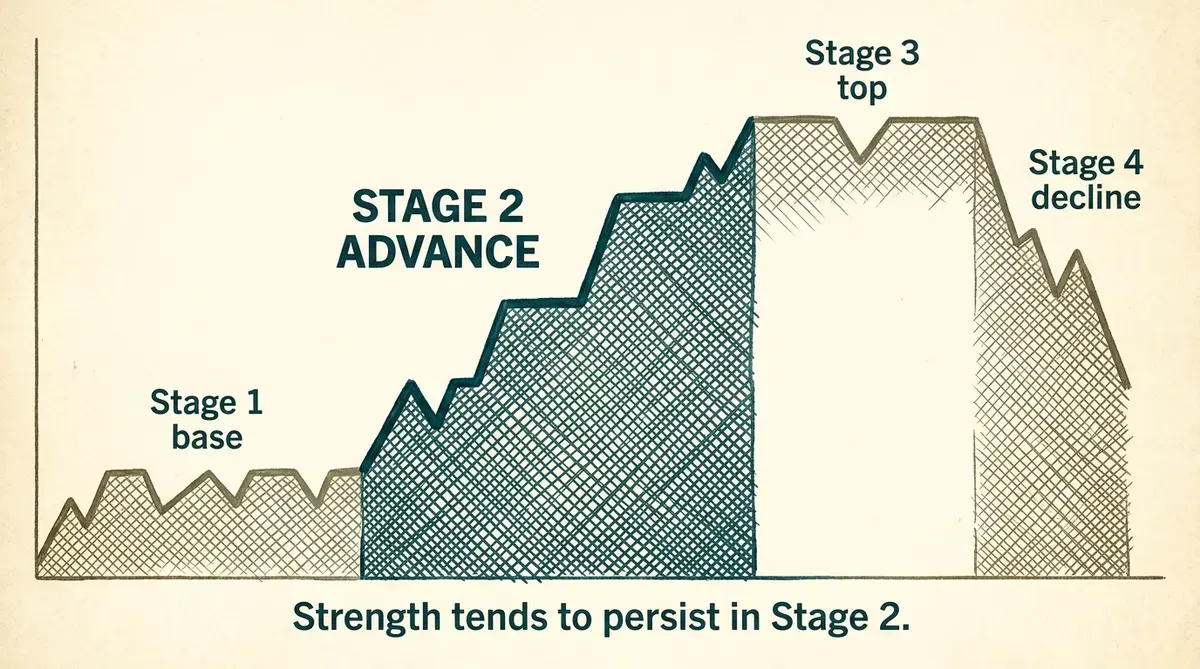
The strange truth about strong stocks
Here's something that surprises almost everyone when they first hear it: stocks that have been going up tend to keep going up.
It feels wrong. Our instincts say the opposite — surely a stock that already rose 50% is "too expensive," and the beaten-down one is the "bargain"? Yet nearly a century of market data says otherwise. Stocks showing strong performance over the past several months have, on average, continued to outperform over the following months. Researchers call this the momentum effect, and it has been documented across decades, across countries, and across asset classes. It is one of the most persistent patterns ever found in markets.
Momentum investing is simply the strategy of buying that strength deliberately: own the market's leaders while they lead, and step aside when they stop.
Why does momentum exist?
If markets were perfectly rational, momentum shouldn't work — everything would be priced correctly the instant news broke. But markets are made of people, and people are predictably slow in some ways and predictably impulsive in others:
- Good news travels slowly. When a company's business genuinely improves — a hit product, an industry tailwind — investors underreact at first. The stock doesn't jump to its new fair value in a day; it grinds toward it over months as more people catch on. That grind is the trend.
- Big money moves slowly. A fund that wants to build a billion-dollar position can't buy it in an afternoon. Institutions accumulate over weeks and months, providing steady demand that keeps a trend alive and supports the stock on dips.
- Success attracts attention. Rising stocks make headlines, get analyst upgrades, and show up on more screens — bringing in new buyers in waves.
Notice what this means: a trend is not "random luck continuing." It's often the visible footprint of a real business improvement being gradually recognized. Momentum investors don't predict the future — they notice recognition happening and join it early.
The anatomy of a big winner
Most of the market's monster stocks — the ones that go up 300%, 500%, 1,000% — follow a recognizable life cycle. A classic way to describe it (popularized by technician Stan Weinstein) is four stages:
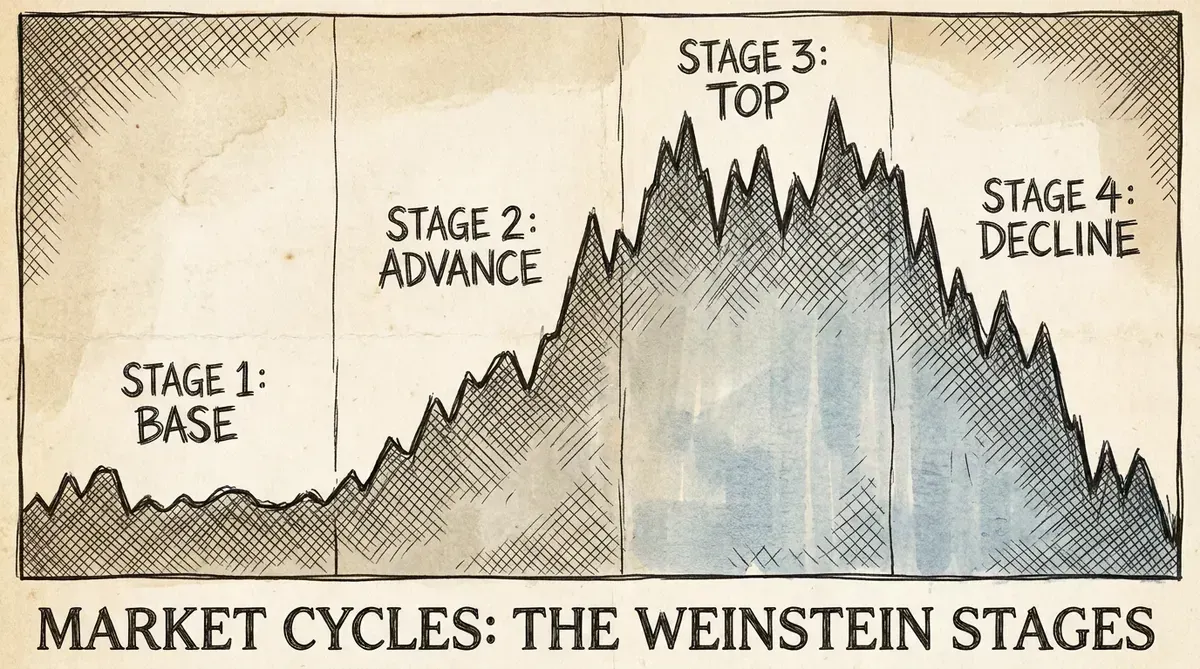
- Stage 1 — The base. The stock goes nowhere for months. Nobody cares. Sellers from the last decline are slowly absorbed.
- Stage 2 — The advance. The stock breaks out of its base and begins a sustained uptrend, typically riding above its key moving averages. This is where essentially all the money is made.
- Stage 3 — The top. The trend stalls. The stock churns sideways violently. Early buyers are selling to latecomers.
- Stage 4 — The decline. The trend reverses. "Cheap" gets cheaper.
The entire craft of momentum investing boils down to one sentence: own Stage 2 stocks, and nothing else.
The momentum investor's toolkit
You don't need dozens of indicators. A few simple tools identify Stage 2 remarkably well:
- Moving averages. A moving average smooths price into a single trend line — commonly the 50-day (the medium-term trend) and the 150- or 200-day (the long-term trend). A healthy Stage 2 stock trades above both, and the 50-day rides above the 150-day. When a stock crosses above its long-term average after months below it, that's often the opening bell of a new trend.
- Relative strength. Is the stock outperforming the overall market? Leaders lead. If the market is flat and your stock is quietly making new highs, someone knows something.
- Volume. Rising volume on up-moves means big buyers are participating. A breakout on huge volume is a statement; the same move on thin volume is a rumor.
- New highs. It sounds scary to buy near highs, but it's mathematically unavoidable: every stock that went up 500% spent that entire journey repeatedly making new highs. New highs are not a warning sign — they're the trail markers of Stage 2.
The part nobody tells beginners: selling
Momentum investing has a dirty secret — the buying is the easy half. The strategy's returns come from a portfolio pattern of small losses and big wins, and that only works if you actually cut the losses. Three rules cover most of it:
- Every position has an exit before you enter. Typically just below a level that would prove the trend broken — under the recent base, or under the long-term moving average.
- A broken trend is a sold stock. When a Stage 2 stock closes decisively below its long-term moving average on heavy volume, the market is telling you the stage has changed. Don't argue. Don't "average down." That's how momentum investors end up holding Stage 4 disasters.
- Let winners run. The counterpart to cutting losers fast is not selling a healthy trend just because you're up 20%. Trends go further than anyone expects — that's the entire source of the strategy's edge.
The real challenge: coverage
Here's the practical problem. In any given month, maybe a few dozen of the thousands of US stocks are beginning genuine Stage 2 advances. To find them consistently you'd need to review the whole market — every chart, every breakout, every moving-average cross — every single day. Professionals solve this with teams and scanning software. Most individuals solve it by... watching the same 20 famous stocks as everyone else, and missing the real leaders entirely.
This is the type of review Relaxfolio is designed to support. Ask in plain English — "trending stocks", "new up trends", or "breakout stocks" — and review the candidates with their trend measures and theme context. The theme structure is important: it groups related companies by the economic or technological force behind them, not only by sector or industry. That makes it possible to assess whether leadership is confined to one stock or shared across suppliers, enablers, and adjacent beneficiaries of the same premise. The investor still determines which evidence matters and how to act on it.
Getting started, sensibly
- Study before you size up. Pull up past big winners and look at their charts. Learn to see Stages 1–4 until it's instinct.
- Start small. Your first momentum positions should be small enough that a stop-loss stings but doesn't scar.
- Respect the market's mood. Momentum works best when the overall market is itself in an uptrend. In rough markets, the best momentum trade is often patience.
- Keep a journal. Write down why you bought, where you'll sell, and what happened. Six months of honest notes will teach you more than any book.
Momentum investing isn't about chasing hot tips or predicting tops. It's a disciplined, evidence-backed way to align yourself with the market's strongest businesses — and to leave when the party's over.
Next in this series: How to Find Breakout Stocks Before They Run and Riding the Trend: Buying Pullbacks and Knowing When to Sell.
Use "trending stocks" to review relative strength, trend measures, and market context across the US equity universe. Explore Relaxfolio →
This article is for educational purposes only and is not investment advice. All investing involves risk, including possible loss of principal.
Put this into practice tonight
Ask Relaxfolio in plain English and get a researched answer in minutes.
Get started