How to Time ETF Entries with Trends and Pullbacks
ETFs fix the "what" of investing — a whole basket in one trade. The harder question is "when." Here's how momentum and swing-style timing apply to ETFs without turning a simple tool into a source of stress.
Why the "when" is the harder question
An ETF solves a real problem: instead of researching hundreds of stocks, you buy a bundle that already holds them. That is the appeal — breadth and simplicity in one ticker. But an ETF does not tell you when to buy, when to add, or when to trim. Two investors can own the exact same fund at different times and get very different experiences of the same holding period.
The "when" of an ETF position is where a momentum or swing mindset earns its keep. These disciplines are not only about individual stocks. The same toolkit — trend, relative strength, and pullbacks within an uptrend — applies to baskets, but with two important differences you need to understand before you start.
Difference 1: A basket smooths the noise, and the signal
Because an ETF holds many names, its chart is smoother than any single stock in it. One company's bad quarter barely moves the fund. That is usually a good thing — but it has a flip side. Individual stocks give momentum traders loud, frequent signals: an earnings spike, a broken average, a volume burst. An ETF gives quieter, cleaner signals. The benefit is fewer false alarms from single-name noise. The cost is that you are timing a broad trend, not a specific company's story.
By definition, an ETF trader is doing trend and rotation work, not single-stock research. You are asking which sectors, themes, or markets are leading — then entering with the trend rather than fighting it.
Trend first: establish the direction before the timing
Every "when" decision starts with a trend question. Before you consider buying an ETF, decide whether the fund is in an uptrend, a downtrend, or a sideways chop — because all the entry timing in the world cannot fix a downtrend.
A practical and widely used way to judge trend with minimal fuss is price relative to its own long-term average. In plain terms: is the fund's price above a meaningful long-term average (its own history over many months), and is that average rising or falling? A fund holding above a rising long-term average is in an uptrend. A fund below a falling average is not, no matter how attractive the recent dip looks.
This is where relative strength comes in. Relative strength asks not just "is this ETF going up" but "is it going up more than its peers and the broad market." A fund can be rising in absolute terms while quietly losing ground to everything around it — a leadership shift you would miss if you only looked at the price line. Momentum investors screen for relative strength precisely because it catches leadership early, while the trend is still intact.
Pullbacks: the momentum entry
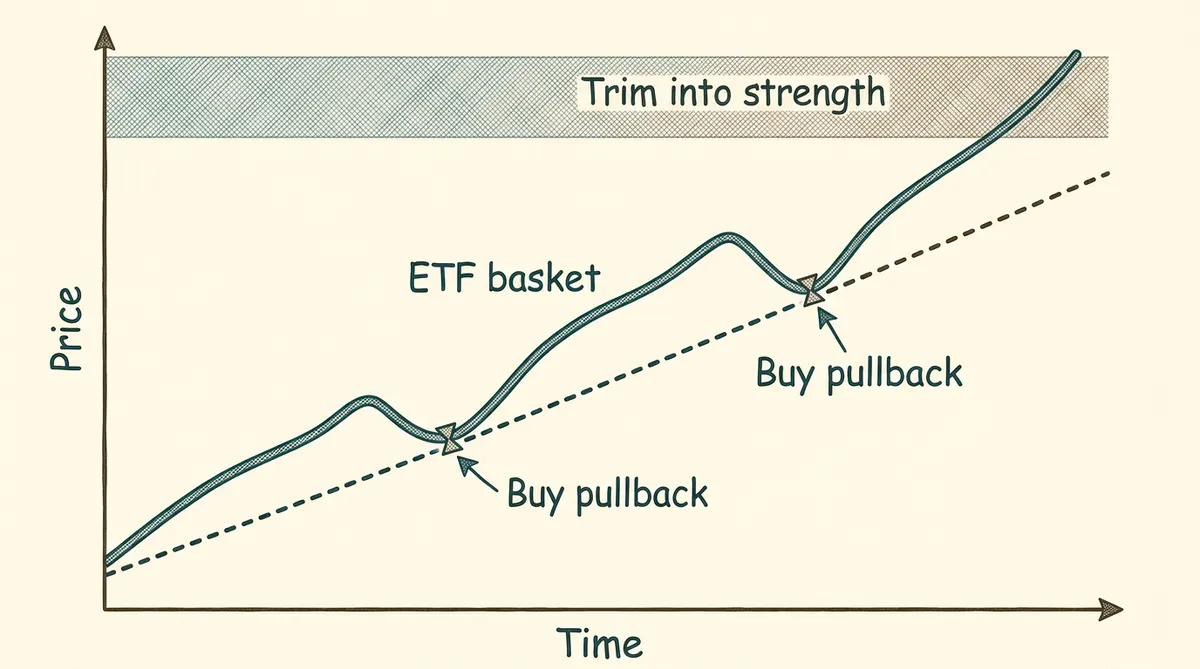
Given an intact uptrend, the swing-style refinement is entering on a pullback rather than chasing strength. A pullback is a brief, temporary decline within an existing uptrend — often a dip toward a rising long-term average — that leaves the broader trend untouched.
Why buy a pullback instead of buying strength? Two reasons:
- Better price, same trend. Entering as the fund touches a rising average gives you a more favorable entry than buying the day it makes a fresh high, without changing the bet you are making.
- A built-in reference for risk. Your stop — the level where you decide the idea is wrong — has a natural home below the recent low or the average the pullback touched. A defined invalidation level is a core part of any momentum or swing process.
The caveat: a pullback only means "opportunity to buy the uptrend" if the uptrend is real and intact. A fund in a downtrend that "pulls back" is not a pullback — it is a falling knife. Trend first, then pullback.
What to check before you act
Before timing an ETF buy or trim, run through a short list:
- Is the fund in an uptrend? Price above a rising long-term average, not just a bounce off support.
- Is relative strength supportive? Is the fund beating its peers and the broad market recently, not merely drifting up with everything?
- Is this a pullback within the trend? A dip toward support or a rising average inside an uptrend — not a breakdown.
- What defines "wrong"? A level where you accept the idea has failed — below the recent low or under the average.
- Do I already own this exposure? With ETFs, overlap is the silent trap. A broad market fund, a sector fund, and a thematic fund can all lean on the same names. Make sure a "new" position is not really a bigger version of what you hold.
Trimming and exits are also "when" decisions
The mirror image of the entry is the exit. An ETF that has run far above its rising average in a short window — a euphoric, vertical stretch — is a candidate for trimming into strength, not a reason to add. And if the fund loses its trend — breaking below its average, or relative strength turning decisively negative — the disciplined move is to reassess the position rather than hold and hope.
The point is not to trade constantly. Most of the time the right answer is: the trend is fine, the fund is not at an extreme, hold and keep reviewing. Timing is for the edges — the entry, the add, the trim, the exit — not for fiddling with a solid position every week.
Keeping it research-driven, not reactive
Timing decisions are best made from a structured review, not from watching a chart all day. A simple, repeatable cadence — screening for leading trends, checking which ETFs are pulling back within those trends, and reviewing your existing exposure for overlap — keeps the process calm and consistent.
This is the kind of review Relaxfolio is built to support. Ask in plain English and review the results:
- "ETF pullbacks" — funds in an uptrend that have pulled back to a rising trend measure, a starting point for review rather than an automatic buy.
- "Trending ETFs" or "ETF heatmap" — a grouped view of recent leadership by sector, theme, or country, so you can see which trends are actually leading.
- "Compare [relevant] ETFs" — review holdings side by side, so a fresh entry is not secretly your existing overlap in a new wrapper.
Two features make this more useful than a raw price table. First, the theme context: Relaxfolio groups related companies and funds by the economic or technological force behind them, not only by sector and industry, so you can tell whether leadership is broad-based or concentrated. Second, you can save a screen and receive updated results by email for ongoing review — so timing a pullback, an add, or a trim becomes a scheduled check-in with a defined scope, not a reactive reaction to a red (or green) day. The investor still decides which evidence matters and how to act on it.
A checklist for timing ETF entries
Before you act on any ETF timing idea, answer five questions:
- Is the fund genuinely in an uptrend — not just bouncing?
- Is relative strength supportive, or is it quietly falling behind?
- Is today's dip a pullback within the trend, or a breakdown from it?
- Have I defined the level that would prove my idea wrong?
- Does the position duplicate exposure I already hold?
Five considered answers will always beat a reflex. The "when" of an ETF is where planning does the heavy lifting — and the reward is buying better entries, trimming into strength, and knowing exactly when an idea has stopped working.
Continue learning: ETF Investing 101 · Sector and Country Rotation with ETFs · How to Measure Relative Strength · Riding the Trend: Buying Pullbacks and Knowing When to Sell
Ask "ETF pullbacks" or "Trending ETFs" to review leading baskets for a structured look at when a well-supported idea makes sense. Explore ETF research → · Open Relaxfolio →
This article is for educational purposes only and is not investment advice. All investing involves risk, including possible loss of principal.
Put this into practice tonight
Ask Relaxfolio in plain English and get a researched answer in minutes.
Get started