Volume Tells the Truth: Relative Volume, Big Movers, and Retail Hype
Price tells you what happened. Volume tells you who was behind it — and whether to believe them.
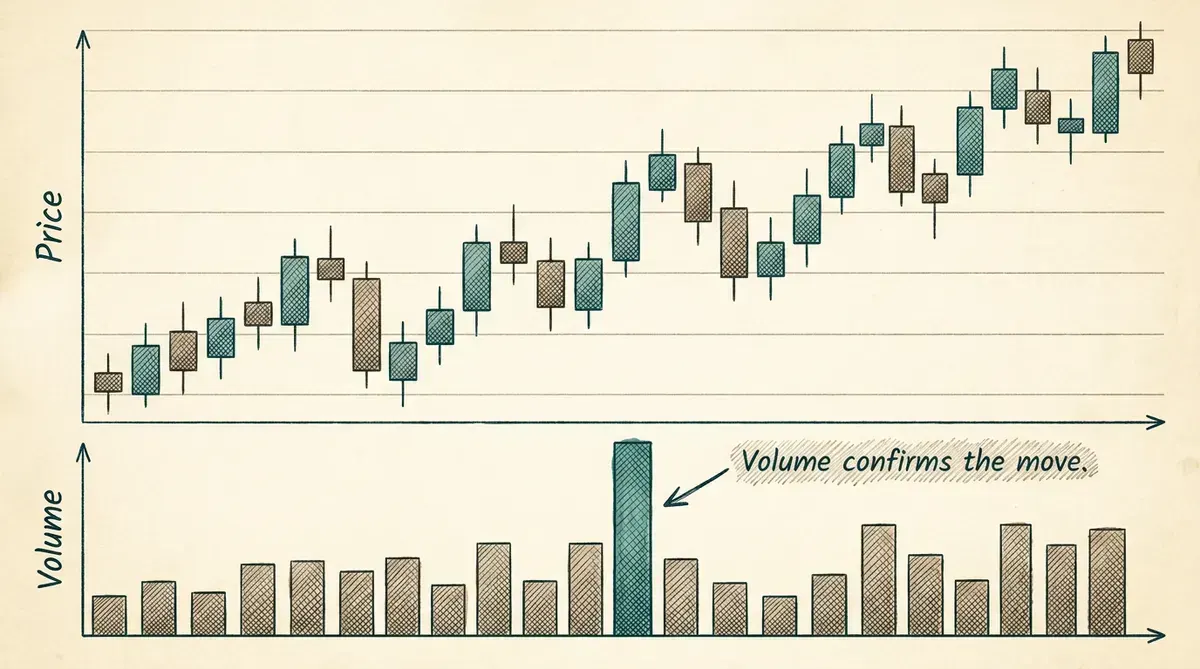
The second dimension of every chart
Most beginners read charts in one dimension: price went up (good) or down (bad). But under every price bar sits a number that tells you how much conviction was behind the move — volume, the count of shares that changed hands.
Why does that matter? Because market moves are only as trustworthy as the money behind them. A stock drifting up 3% on a trickle of shares is an opinion held by a few small traders. The same 3% on five times normal volume is institutions committing serious capital — pension funds and asset managers whose buying takes days or weeks to complete, and whose footprints therefore persist. Price is the claim; volume is the evidence.
Three practical translations:
- Rally on expanding volume → big money participating; the move has fuel.
- Rally on shrinking volume → running on fumes; treat with suspicion.
- Decline on light volume → holders relaxed, mostly an absence of buyers — often just a rest.
- Decline on heavy volume → someone large is leaving. Respect it.
Relative volume: making "unusual" measurable
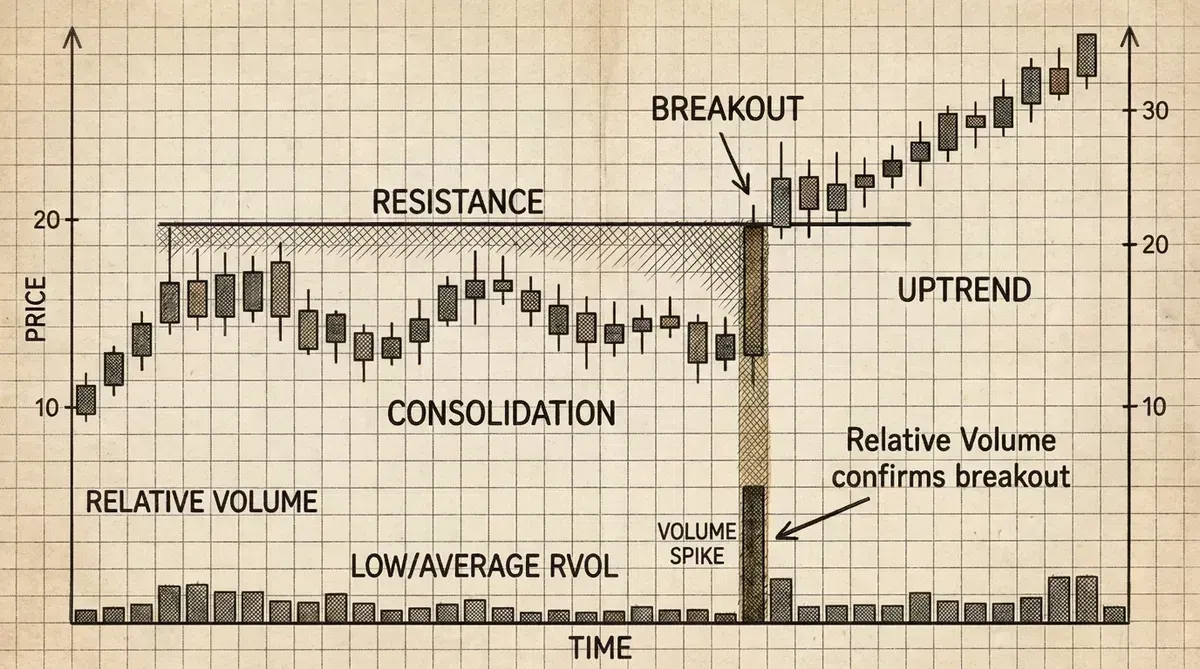
Raw volume numbers are meaningless in isolation — a million shares is a dead day for a mega-cap and a once-a-decade event for a small-cap. The fix is relative volume (RVOL): today's volume divided by the stock's own recent average.
- RVOL ≈ 1 — a normal day. Nothing to see.
- RVOL ≥ 2 — twice the usual interest. Something changed: news, an upgrade, a discovery. Worth a look.
- RVOL ≥ 5 — the stock is having one of its most important days of the year. Whatever is happening, the market considers it a big deal — and after volume shocks like this, stocks often begin multi-week repricings rather than finish them.
Relative volume is the single fastest filter for "which of today's movers actually matter." A 4% pop at normal volume is noise. A 4% pop at RVOL 6 is an event — and events have follow-through.
Reading the day's big movers
Every session produces a leaderboard of big gainers and losers, and it's the most information-dense page in the market — if you interrogate it instead of just browsing it. For each big mover, three questions:
- What's the reason? Earnings beat, contract win, FDA decision, sector-wide surge, or... nothing findable? Moves with real causes are analyzable; moves without them are usually games you're not invited to.
- What's the volume? A gainer on RVOL 8 with real news may be day one of a new trend and belongs on your watchlist. A gainer on modest volume with no news will likely round-trip.
- Is it one stock, or a connected group? A useful question on any movers list is whether several companies exposed to the same theme are moving together. One uranium stock up 6% may be a company-specific story. Similar activity among miners, equipment suppliers, fuel-cycle businesses, or related ETFs may suggest a broader theme rotation. Theme structures matter because those relationships can cross conventional sector and industry classifications.
This is also where checking the earnings calendar pays off twice: it explains half the movers list, and it warns you which of your own positions face a binary event this week.
Retail hype: when volume lies
There is one situation where crowd participation makes volume less trustworthy: the social-media stampede. The pattern is a genre by now: a stock catches fire on social platforms, search interest goes vertical, the price doubles in days on colossal volume — then, once the last latecomer has bought, collapses just as fast. The volume was real, but it was thin conviction — thousands of small accounts buying a story, with no institutional accumulation underneath to catch the fall.
How to tell hype-driven volume from institutional volume:
- Trajectory. Institutions accumulate for weeks (persistent, elevated-but-orderly volume; stair-step advances). Hype arrives overnight (vertical price, record volume, gap after gap).
- Cause. Institutional moves usually trace to fundamentals — earnings, contracts, industry data. Hype traces to virality itself: the story is that everyone's talking about it.
- Social footprint. When a stock's search interest and social mentions explode to many multiples of their normal baseline, you are watching attention, not analysis. Attention exhausts; there is always a last buyer.
None of this means hyped stocks can't be traded — some traders specialize in them — but it must be done knowing what the move is: a crowd-psychology event with a countdown timer, demanding tiny size and ruthless exits. What's fatal is the middle path: buying a hype spike believing it's an investment.
Relaxfolio tracks this for you: when a fast-rising stock's search interest or social-media mentions spike to extreme multiples of their baseline, the stock gets flagged for retail hype in its notes. It's one of the most useful warnings in the product — the difference between buying a business and buying a moment.
A nightly volume routine
Fold volume into your evening process (it slots straight into the routine from Swing Trading 101):
- "Biggest movers" — scan the day's leaders and laggards, with reasons researched and relative volume shown. Use the theme structure to identify connected clusters, including businesses that would not appear in the same industry list.
- Check your setups' volume behavior. Pullbacks should be quiet; breakouts must be loud. (The patterns are covered in The Anatomy of a High-Probability Swing Setup.)
- Vet any candidate for hype flags. Early institutional accumulation is a green light; a retail-hype flag at the top of a vertical move is the opposite.
- "Upcoming earnings" — clear this week's calendar for everything you hold or plan to enter.
Relaxfolio supports this review in plain English across the US market, presenting relative volume and retail-attention context alongside the relevant price action. These inputs can help an investor assess whether a move merits further work.
Price is what the market says. Volume is whether it means it. Learn to hear the difference and you'll stop being the person the movers list is designed to fool — and start being the one it informs.
To investigate a market move in context, ask Relaxfolio for "biggest movers". Explore Relaxfolio →
This article is for educational purposes only and is not investment advice. All investing involves risk, including possible loss of principal.
Put this into practice tonight
Ask Relaxfolio in plain English and get a researched answer in minutes.
Get started