How to Spot a Value Trap Before It Traps You
Some stocks are cheap the way a sale is cheap. Others are cheap the way a sinking ship is cheap. Here's how to tell the difference.
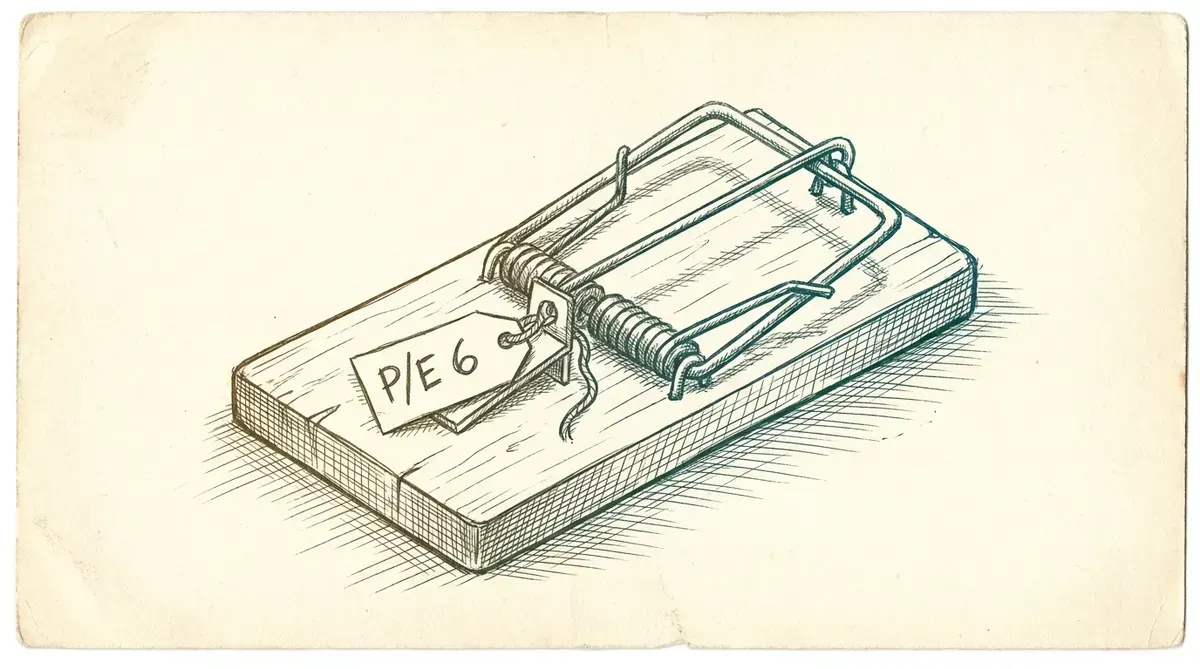
The most expensive word in investing is "cheap"
Every value investor eventually meets the same seductive stock. The P/E is 6 when the market's is 20. It pays a fat dividend. The brand is a household name. Every metric screams bargain — and after you buy, it gets cheaper. And cheaper. The dividend gets cut. Five years later you've lost half your money in a "safe" stock while the boring index doubled.
That's a value trap: a stock that looks statistically cheap but is actually priced correctly — or generously — for a business in decline. The trap works because it exploits the one thing value investors are trained to do: buy low. The whole game is learning to ask not "is it cheap?" but "why is it cheap?"
There are only two honest answers. Temporary reasons — a fixable stumble, an out-of-favor sector, market panic — are opportunities. Terminal reasons — a dying product, a broken moat, a melting industry — are traps. Everything below is a technique for telling them apart.
Trap sign #1: The revenue trend is a story with an ending
Open the long-term revenue chart. A cheap stock with revenue that has declined steadily for years isn't being ignored by the market — it's being measured by it. Declining revenue means the business is shrinking, and a shrinking business's "cheap" earnings are borrowed from a smaller future.
Contrast that with a company whose revenue keeps compounding while the stock fell 30% on a scary quarter or a sector-wide panic. Same low price tag, opposite meaning.
The test: would you rather own this business's next ten years than its last ten? A real bargain is a discount on the future. A trap is full price on the past.
Trap sign #2: The industry has a fatal disease
Individual companies can fight decline; entire industries usually can't. Video rental, print directories, film cameras, mall-based retail — each spent years looking statistically cheap on the way to oblivion, and every ratio was "right" except the one that mattered: total demand for what they sold was going away.
This is why understanding a company's theme — the technology, demand driver, or value-chain relationship that explains what it actually does and where that market is heading — is as important as any ratio. A theme framework can also reveal relevant suppliers, beneficiaries, substitutes, and adjacent competitors that a narrow industry peer set may omit. A company can post fine margins while standing on a melting iceberg.
The test: is the company's addressable market growing, flat, or shrinking? Is there a substitute technology getting cheaper every year? If the honest answer is "shrinking, and yes," no P/E is low enough.

Trap sign #3: The earnings are cyclical — and you're at the peak
Here's a cruel joke the market plays on ratio-screeners: cyclical companies look cheapest at exactly the wrong moment. Steel, shipping, autos, semiconductors, homebuilders — their earnings balloon at the top of their cycle. Booming earnings + cautious stock price = a gorgeous low P/E... right before earnings collapse and that P/E of 5 becomes a P/E of 50 on the same share price.
The test: compare today's profit margins to the company's own 10-year history. If margins are at record highs in a famously cyclical industry, mentally cut the earnings in half (or worse) and re-ask whether it's cheap. Often the truly courageous cyclical buy is when earnings look terrible — the opposite of what the screener shows.
Trap sign #4: The balance sheet has a fuse
Debt turns problems into death spirals. A struggling company with no debt can cut costs, pivot, and wait out a storm for years. The same company with heavy debt has a countdown clock: interest payments don't pause for turnarounds, and refinancing during trouble ranges from expensive to impossible. Many famous "value" collapses were, at root, debt collapses — equity holders were wiped not because the business vanished but because creditors got everything first.
The test: debt-to-equity, trend of total debt, and whether free cash flow comfortably covers interest and the dividend. A dividend yield of 9% funded by borrowing isn't income — it's bait. Dividend cuts are almost always foreshadowed by cash flow that stopped covering the payout.
Trap sign #5: The insiders are heading for the exits
Management sees the order book, the customer churn, the internal forecasts — everything you can't. So watch their wallets:
- Heavy, broad insider selling while the stock is already depressed is a grim signal. (A single executive selling a little is noise — diversification, houses, divorces. Many executives selling a lot is a message.)
- Insider buying — real purchases with their own cash, especially by several insiders at once — is among the most reliable "temporary, not terminal" signals in the market. People don't buy more of a ship they know is sinking.
- Buybacks tell the truth about confidence too. A company aggressively retiring shares at low prices believes in its future; one that quietly stopped buying back (or is issuing new shares to survive) is telling you something.
The trap-detection routine
The defense against value traps isn't genius — it's completing the checklist before the purchase, on full information. In practice that means, for every "cheap" candidate: multi-year revenue and margin trends, industry direction, cycle position, debt structure, cash flow versus dividend, insider activity, and what's actually in the news. That used to be a week of digging per stock — which is precisely why most people skipped it and got trapped.
Relaxfolio organises this review around a ticker or research question: revenue, earnings, and margin trends; leverage; products and themes; business-strength and growth considerations; and material developments with their potential implications. Its theme structure is useful here because it connects the company to businesses exposed to the same driver, supply chain, or substitute risk—not merely its formal industry. Ask "insider buying" or "significant insider selling" to examine reported ownership activity, then compare the company with the direction of the relevant theme.
The stocks that pass this gauntlet — genuinely cheap, genuinely healthy, temporarily hated — are the ones the strategy was always about.
The final question
Before buying anything cheap, answer in one written sentence: "This stock is cheap because __, and that reason is temporary because ____."
If you can't fill in both blanks convincingly, you don't have a value investment — you have a lottery ticket with a low P/E. Pass, and let the market offer you a better gift. It always does.
Also in this series: Value Investing for Beginners and Follow the Smart Money: 13F Filings and Insider Buying.
Use Relaxfolio to organise the relevant questions around a potential value candidate. Explore Relaxfolio →
This article is for educational purposes only and is not investment advice. All investing involves risk, including possible loss of principal.
Put this into practice tonight
Ask Relaxfolio in plain English and get a researched answer in minutes.
Get started