How the US Stock Market Really Works: A Field Guide for New Investors
Everything a beginner actually needs to know about the world's biggest market — and nothing they don't.
What you're actually buying
Start with the thing itself: a share of stock is a piece of ownership in a real company. Buy one share of Apple and you own a sliver of every iPhone sold, every dollar of profit, every building and patent. You're not buying a lottery ticket or a blip on a chart — you're becoming a (very small) business owner.
This single idea explains almost everything else. Stocks go up over time because businesses grow: they sell more, earn more, and each ownership slice becomes more valuable. The US market's long-term rise isn't magic — it's the compounded output of the most productive companies on earth, and anyone with a brokerage account can own a piece.
The map: how the market is organized
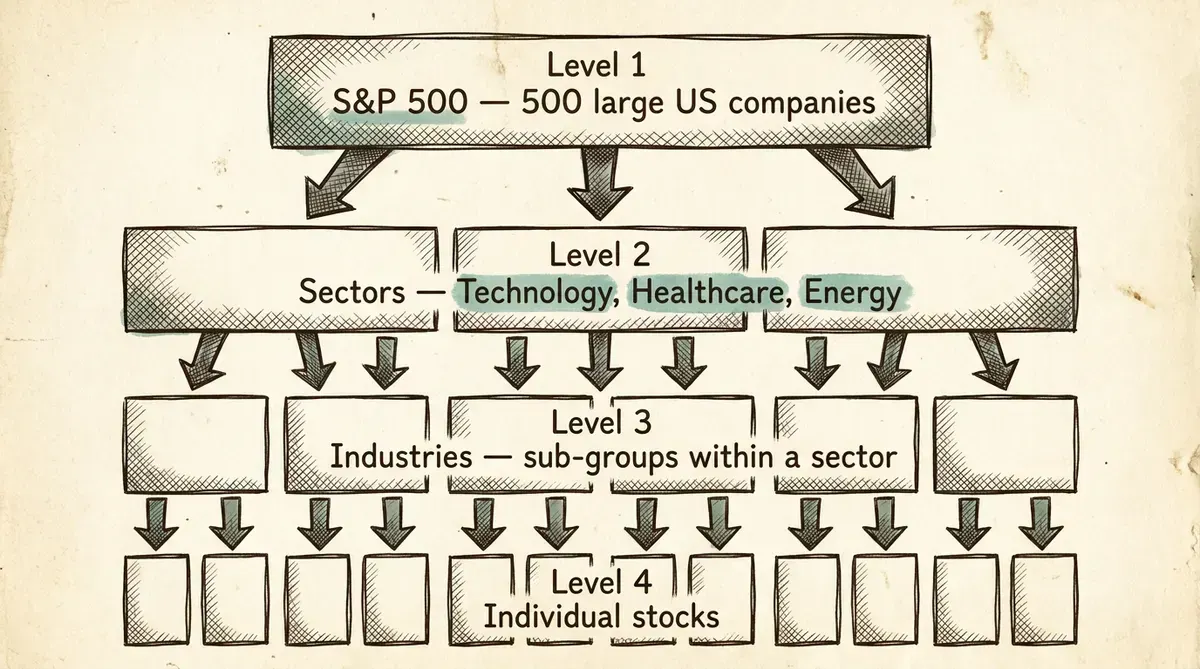
The US market has thousands of listed companies. Nobody — not even professionals — thinks about them one by one. Everyone uses groupings, and learning them is like learning the map of a new city:
- Indexes are the market's scoreboards. The S&P 500 tracks ~500 of the biggest US companies and is what people mean by "the market." The Nasdaq leans tech-heavy; the Dow is 30 famous giants.
- Market cap is a company's total price tag (share price × number of shares). Large caps are the trillion-dollar giants; small caps are riskier, faster-moving companies. Price per share alone means nothing — a $900 stock can be a smaller company than a $20 one.
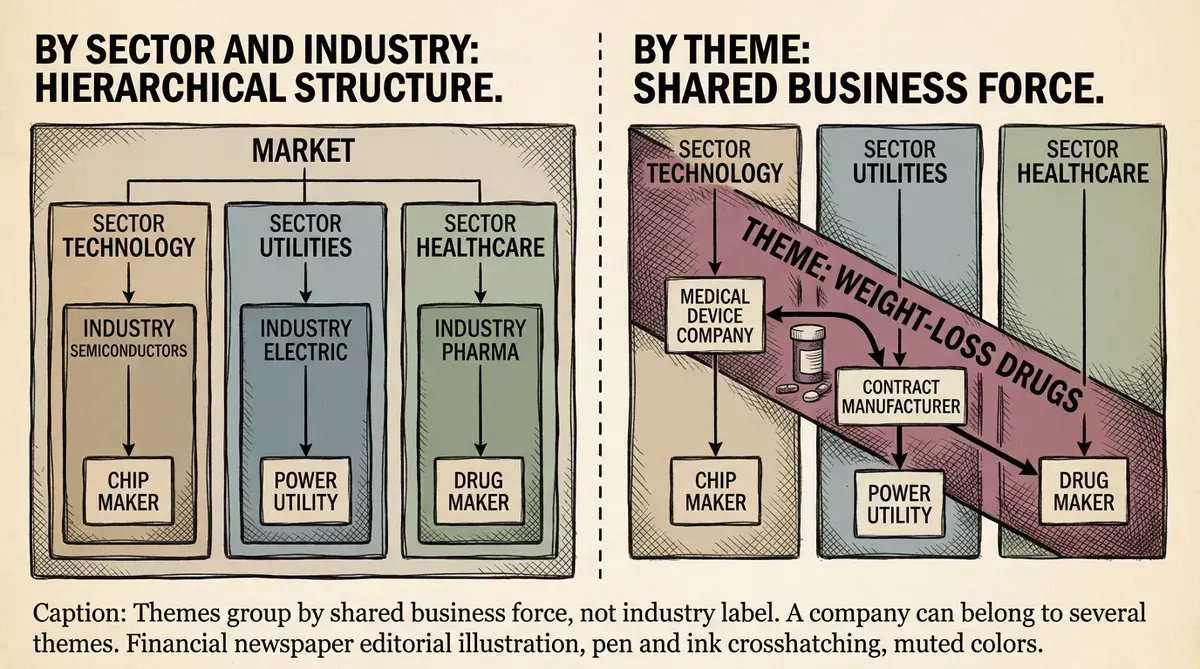
- Sectors and industries group companies by what they do — Technology, Healthcare, Energy, Financials, and so on, each subdividing further. This matters because stocks move in schools: when oil prices jump, most energy stocks rise together. Half of a typical stock's movement is really its group moving.
- Themes are a complementary organising layer built around the actual business force: artificial intelligence infrastructure, drones, weight-loss drugs, rare-earth materials, or another technology, demand driver, or value-chain relationship. Unlike a sector or industry classification, a theme can connect businesses across those labels, and the same company can be relevant to several themes.
- ETFs are baskets of stocks that trade like a single stock — one purchase buys the whole S&P 500, or a whole sector, or a whole country's market. They're how beginners can own broad slices without picking individual names, and how everyone else reads which groups are in demand.
What actually moves prices
Here's the mental model that separates informed investors from headline-followers. A stock's price is the market's live estimate of the business's future, so it moves when expectations about the future change:
- Earnings — the big one. Four times a year each company reports results, and prices can jump or crash 10%+ in a day, not on whether results were "good," but whether they beat or missed what the market expected. A company can grow 20% and fall — because 25% was expected.
- Interest rates — the market's gravity. Rates (steered by the Federal Reserve) set the return money can earn safely. When rates rise, future profits are worth less today, and stock prices — especially of fast-growing companies whose profits are mostly in the future — feel the pull.
- The macro backdrop — inflation, employment, economic growth, geopolitics. These push entire sectors in and out of favor and set the market's overall mood between risk-on (optimism, growth stocks lead) and risk-off (fear, defensive stocks and cash lead).
- Stories and sentiment — in the short run, attention itself moves prices. Themes catch fire; crowds pile in and out. Over months and years, though, prices gravitate back to business reality. As the saying goes: in the short run the market is a voting machine, in the long run a weighing machine.
Notice what's absent from this list: yesterday's price move, a stranger's confidence on social media, and your feelings about the brand. All three are how beginners get separated from their money.
Your first tools: learning to see the market
You now know enough to start observing like a professional. Three habits build market intuition faster than anything else:
1. Watch the whole board, not one square. A heatmap shows every major stock as a tile — sized by company value and colored by performance — so one glance shows which groups are contributing to market activity. A theme heatmap adds a more specific question: are related companies participating in a shared technology, demand driver, or value chain, even when they sit in different sectors?
2. Get one company explained, completely. Pick a business you already understand as a customer — Apple, Nike, Starbucks — and type its ticker into Relaxfolio. You'll get the two-year price chart, revenue and profit trends, what the company actually sells, its strengths and risks, and the news that matters with implications explained. That's the professional research packet, in plain English. Read five of these and you'll know more about analyzing companies than most people who've owned stocks for a decade.
3. Follow the market's story. Read market commentary to see how investors connect the dots between economic conditions, sector leadership, and company-specific developments. It helps turn isolated observations into a broader market framework.
The beginner's protective rules
Education first, but guardrails immediately:
- Only invest money you won't need for years. Markets drop 10–20% regularly and always have. The investors who get hurt are the ones forced to sell during the drop.
- Start diversified. A broad index ETF as your foundation means no single company can wreck you while you learn.
- Position-size your curiosity. Individual stock picks while learning should be small — think tuition, not fortune-making.
- If you can't explain why you're buying, don't buy. "It went up a lot" and "someone online loves it" are how beginners fund other people's exits.
- Judge decisions, not outcomes — in writing. Keep a one-line journal of every buy: the reason. Reviewing it quarterly is the fastest self-education in finance.
Where to go from here
You now hold the actual foundations: stocks are businesses, the market is organized in groups, prices move on expectations, and intuition comes from daily observation. The natural next step is discovering which style of investing fits your temperament and schedule — momentum, value, swing trading, or patient indexing-plus. That's the subject of the next guide: Choosing Your Investing Style.
Choose a company you know and use Relaxfolio to organise the questions worth investigating. Explore Relaxfolio →
This article is for educational purposes only and is not investment advice. All investing involves risk, including possible loss of principal.
Put this into practice tonight
Ask Relaxfolio in plain English and get a researched answer in minutes.
Get started